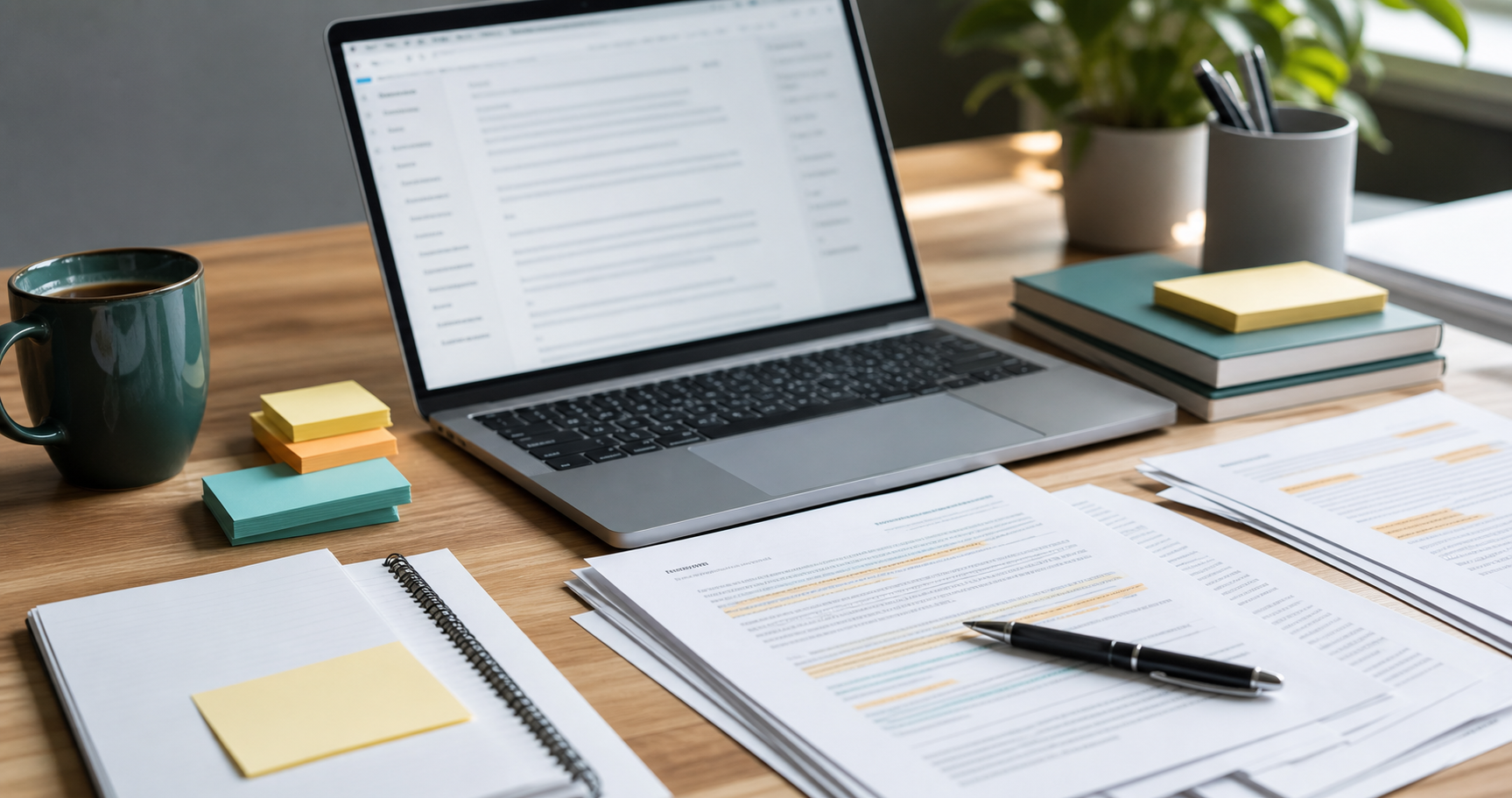
A source map pass helps AI-assisted drafts earn trust by tying every important claim to the evidence, experience, or judgment behind it.
Confidence Is Not The Same As Support
AI-assisted drafts often sound confident before they have earned confidence.
The sentences are clean. The argument moves forward. The language does not hesitate. That polish can be useful, but it can also hide a basic problem: the reader cannot tell where the draft gets its certainty.
A source map pass fixes that problem.
It is a revision step where you trace the important claims in a draft back to their support. Some claims need a source. Some need an example. Some need a limit. Some need to be removed because they are only fluent guesses.
The goal is not to cover the page in citations. The goal is to make the draft easier to trust.
Start By Marking The Load-Bearing Claims
Not every sentence needs the same level of checking.
Start by finding the load-bearing claims. These are the statements a reader must believe for the article, email, policy, landing page, or report to work.
Look for sentences that include numbers, trends, comparisons, risk, legal or academic advice, customer promises, scientific claims, product capabilities, or broad statements about what "most" people do.
Also look for hidden claims. A sentence like "This workflow saves teams hours every week" is not just motivational copy. It makes a measurable promise. A sentence like "AI detectors often misread careful human writing" points to a real debate about false positives. A sentence like "This approach works for every team" is probably too broad.
During the source map pass, highlight these load-bearing claims before rewriting anything.
The highlight tells you where trust is being spent.
Assign Each Claim A Support Type
Once the important claims are visible, assign each one a support type.
Some claims need external evidence. If the draft mentions a study, policy, platform behavior, pricing model, law, or market trend, the reader may need a real source.
Some claims need internal evidence. A company may support a claim with product analytics, customer tickets, support logs, sales calls, or user research. That evidence may not be public, but the draft should still reflect the fact that someone checked it.
Some claims need lived experience or expert judgment. Not every useful observation comes from a report. A support manager can explain a recurring customer confusion. A teacher can describe where students misuse AI tools. An editor can recognize a draft that sounds polished but unsupported.
Some claims need a concrete example instead of a citation. If the draft says "generic advice weakens trust," show a generic sentence and a stronger revision.
Some claims need a limit. The most honest support may be a boundary: "This applies to short marketing drafts, not legal filings" or "This is a review workflow, not a guarantee that every detector will agree."
Support type matters because it keeps the edit practical. You are not asking every sentence to become academic. You are asking every important sentence to show why it deserves confidence.
Watch For Borrowed Certainty
Borrowed certainty is one of the easiest problems to miss in AI-assisted writing.
It happens when a draft uses the tone of expertise without the work of expertise.
You can hear it in lines like:
- "Research shows that..."
- "Everyone knows..."
- "The best teams always..."
- "This guarantees..."
- "In today's rapidly changing landscape..."
Some of these phrases can be true in context. The problem is that they often arrive without enough support.
During the source map pass, ask a simple question: if a reader challenged this sentence, what would we point to?
If the answer is "nothing," the sentence needs to change.
You might add the missing source. You might narrow the claim. You might replace certainty with observation. You might remove the line entirely.
For example, "AI detectors are unreliable" is too broad. A stronger version is, "Detector scores should be treated as signals rather than verdicts, because false positives and false negatives can occur, especially when writing style, language background, and editing history are not considered."
That sentence is still cautious, but it gives the reader a clearer reason to trust the judgment.
Build A Simple Claim Table
For important drafts, make the source map visible outside the prose.
Create a simple table with four columns:
- Claim
- Support
- Risk if wrong
- Revision needed
The claim column names the sentence or idea. The support column lists the source, internal evidence, example, expert review, or limit. The risk column explains what happens if the claim is wrong. The revision column says what to do next.
This table does not need to be shown to readers. It is an editorial tool.
It helps teams separate sentences that are merely awkward from sentences that are risky. It also prevents last-minute polishing from making weak claims sound more authoritative than they are.
If the risk is low, a better example may be enough. If the risk is high, the claim may need a source, legal review, product confirmation, or removal.
Do Not Let The Source Map Flatten The Voice
Evidence should not make writing wooden.
A common mistake is to respond to weak AI writing by adding stiff citations, caveats, and compliance language until the draft becomes hard to read. That solves one problem by creating another.
The source map pass should make the writing clearer, not heavier.
Use the support to sharpen the sentence.
Instead of: "Studies prove that clear examples improve trust."
Try: "Readers trust the advice faster when they can see it working in a real sentence."
If you have a source, cite or link it where appropriate. If the piece is not citation-heavy, let the evidence shape the specificity of the claim. The reader does not always need to see the entire backstage process, but they should feel that the writer has done the work.
Check The Gaps Between Sources
Many AI drafts do not fail because one claim is unsupported. They fail because the bridge between supported claims is weak.
A draft may cite a real statistic, then jump to a recommendation that the statistic does not fully justify. It may quote a policy, then make a product claim. It may describe a general trend, then imply that every reader should act the same way.
During the source map pass, look at the gaps between sources.
Ask whether the conclusion actually follows from the evidence. If it does not, add the missing reasoning or soften the recommendation.
This is where human judgment matters most.
AI can gather, summarize, and rephrase, but someone needs to decide whether the evidence supports the claim being made. That responsibility belongs to the person or team publishing the final draft.
Use AI To Find Claims, Not To Approve Them
AI can help with the source map pass if you keep the role narrow.
Ask it to list claims that need support. Ask it to identify broad statements, numbers, comparisons, and promises. Ask it to flag places where a skeptical reader might ask, "How do you know?"
Then review the list yourself.
Do not ask the same system that generated the confident draft to certify that the draft is trustworthy. That creates a loop where unsupported confidence can reinforce itself.
Use AI as a scanner. Use human review as the approval step.
The Final Draft Should Show Its Work
A strong AI-assisted draft does not have to announce every edit behind it.
But it should show its work where it matters.
It should distinguish facts from interpretations. It should avoid universal claims when the support is narrower. It should use examples that feel observed. It should make promises only where the writer is willing to stand behind them.
The source map pass is how you get there.
It turns a polished draft into an accountable draft. It gives editors a way to see which sentences are ready, which need evidence, and which are pretending to know more than they do.
That is what makes AI-assisted writing more credible.
Not a smoother surface.
Not a lower detector score.
A clearer trail from claim to support to responsible final judgment.
Want to Make Your AI Content Undetectable?
Our AI humanizer uses advanced techniques to transform AI-generated text into natural, human-like writing that bypasses all major detectors.
Try Free →